

Enterprise AI Prompt Rewriter & Model Target Compiler
Stop pasting vague text drafts into Large Language Models. Ingest raw seed prompts, operational constraints, and context attachments—and compile them into production-ready system instructions optimized specifically for Anthropic Claude, Google Gemini, and OpenAI GPT.
Interactive Prompt Compiler Console
Select a quick preset blueprint or enter your unrefined seed task below to generate model-tuned system instructions.
Quick Preset Blueprints
Click any architecture template below to load production-grade prompt specifications instantly.
1. Ingestion & Architecture Target
2. Operational Boundaries & Context
3. Multi-Metric Optimization Profile
<identity>
You are a Principal Software Architect and Lead AI Engineer specializing in deterministic logic, type-safe implementations, and zero-hallucination analysis.
</identity>

<context>
// Internal API Schema: /api/user/:id returns UserRecord { id: string, name: string, email: string, role: "admin" | "user" }
</context>

<instructions>
1. Analyze the incoming user input payload thoroughly.
2. Verify compliance against all explicit constraints listed in this system message.
3. Execute the primary objective: "fix this function make it cleaner add error handling and typescript types function fetchUserData(id) { fetch("/api/user/"+id).then(r=>r.json()).then(d=>console.log(d)) }".
4. Format the final output strictly according to the designated output structure.
</instructions>

<examples>
  <example index="1">
    <input>
function getSum(a, b) { return a + b; }
    </input>
    <output>
/**
 * Calculates the sum of two numeric values.
 * @param a - First summand
 * @param b - Second summand
 * @returns The total sum
 */
export function getSum(a: number, b: number): number {
  if (typeof a !== "number" || typeof b !== "number") {
    throw new TypeError("Both arguments must be valid numbers.");
  }
  return a + b;
}
    </output>
  </example>
</examples>

<output_instructions>
- Must handle HTTP error status codes (4xx, 5xx) with explicit Error throwing
- Must return strongly typed Promise<UserRecord>
- Use async/await syntax instead of raw promise chaining
- Include JSDoc documentation with @param and @returns tags
</output_instructions>

<thinking_control>
For complex or multi-layered inputs, allocate internal <thinking> reasoning tags before producing the final response payload.
</thinking_control>OpenTelemetry Audit Span Trace (Milestone 6)
{
  "trace_id": "tr_aiq_99a8b1c4e2",
  "span_id": "sp_compiler_01",
  "target_architecture": "claude-3-7-sonnet",
  "taxonomy": "technical",
  "quality_score": 99,
  "token_expansion_ratio": "10.07",
  "estimated_latency_ms": 670,
  "utility_metric_u": 74,
  "telemetry_status": "SUCCESS_COMPILED"
}What is the Enterprise Prompt Rewriter & Target Compiler?
The expansion of Large Language Model (LLM) architectures transformed prompt engineering from an empirical trial-and-error exercise into a formal software engineering discipline. Modern enterprise AI applications require prompts that function as robust, deterministic software modules capable of maintaining high execution accuracy while minimizing token overhead and request latency.
Software developers lose up to 42 percent of their time managing technical debt and debugging opaque AI generations. Naive prompt rewriting tools fail primarily because they rely on an unstructured, single-input text box. Forcing backend LLMs to infer intent, system boundaries, formatting preferences, and model targets simultaneously yields generic, uncalibrated, and hallucination-prone output prompts.
Axiqual's Prompt Rewriter & Target Compiler bridges the gap between programmatic prompt search frameworks (such as DSPy, TextGrad, and ProTeGi), enterprise LLMOps telemetry platforms (LangSmith, FutureAGI, PromptLayer), and pattern-based human augmentation frameworks (Fabric). Rather than executing a simple rephrase, our platform unifies a 6-stage engineering pipeline:
- 1. Multi-Parameter Ingestion Pipeline
- 2. Metaprompt Structural Expansion
- 3. Provider-Specific Target Compilers
- 4. Output Suite & Visual Git-Style Diffs
- 5. Tri-Axis Telemetry & Utility Scorecard
- 6. Developer SDK & IDE Export Bindings
Market Landscape vs Axiqual Architecture
Offline algorithmic search; requires complex Python pipelines & continuous dataset optimization loops.
Single unconstrained text box; lacks target model compilation, dynamic variable extraction, or cost profiling.
Unifies multi-parameter ingestion, top-loaded RAG context, Claude/Gemini/GPT target compilers, live form hydrators, visual diffs, and OpenTelemetry trace spans in one instant utility.
Ingestion Engine
Captures seed task, target model family, task taxonomy, operational constraints, dynamic variables ({{VAR}}), RAG context, and few-shot pairs.
Model Compilers
Translates requirements into Anthropic Claude nested XML tags, Google Gemini Persona-Rules-Guardrails sequences, and OpenAI GPT System headers.
Output & Telemetry
Delivers compiled system instructions, live variable form hydrator, visual git diff, telemetry scorecard ($U(P^*)$), and SDK bindings.
Why Enterprise Engineering Teams Rely on Target Compilation
Unoptimized prompts waste API token budgets, introduce latency overhead, and produce inconsistent outputs across model providers. Here is why structured prompt compilation is essential for production AI software:
30% Accuracy Boost via Top-Loaded Context
Empirical testing proves that top-loading longform documentation, API schemas, or code signatures near the top of the prompt payload—above instructions—boosts context adherence by up to 30%.
Provider-Native Model Syntax Alignment
Claude excels with nested XML tags (<instructions>). Gemini thrives with Persona-Rules-Guardrails structures. GPT relies on Markdown headers and JSON schemas.
Telemetry & Cost-Latency Balance
Every compiled prompt calculates an explicit Utility Score $U(P^*)$ balancing execution quality gain against token expansion ratio and latency impact.
1-Click SDK Code Export Bindings
Export compiled system prompts directly into Python (anthropic, google.genai, openai), TypeScript SDKs, LangChain templates, or VS Code/Cursor snippets.
The Multi-Metric Utility Formula $U(P^*)$
Optimizing prompts requires balancing output quality against API token costs and invocation latency.
In this formulation, $S(P^*)$ represents the composite quality score across instruction adherence and schema compliance. $C(P^*)$ is the normalized token cost expansion ratio, while $L(P^*)$ is the normalized execution latency. Non-negative weights satisfy $\alpha + \beta \le 1$, giving engineering teams explicit mathematical control over context window economics.
Real-World Before & After Prompt Compilation
Compare unrefined seed drafts with compiled system prompts across different LLM architectures and domain taxonomies.
Example 1: Unstructured Code Refactoring (Target: Anthropic Claude 3.7)
fix this function make it cleaner add error handling and typescript types function fetchUserData(id) { fetch("/api/user/"+id).then(r=>r.json()).then(d=>console.log(d)) }
<identity>
You are a Principal Software Architect and Lead AI Engineer specializing in deterministic logic, type-safe implementations, and zero-hallucination code refactoring.
</identity>

<context>
// Internal API Schema: /api/user/:id returns UserRecord { id: string, name: string, email: string, role: "admin" | "user" }
</context>

<instructions>
1. Analyze the incoming unrefined TypeScript/JavaScript function.
2. Refactor raw promises into async/await syntax.
3. Throw explicit Error instances on 4xx/5xx HTTP status codes.
4. Export strongly-typed return signatures matching UserRecord.
</instructions>

<thinking_control>
Allocate internal <thinking> tags before generating the refactored code payload.
</thinking_control>
Example 2: Support Ticket Sentiment Classifier (Target: OpenAI GPT-4o)
Read user ticket and tell me if they are mad, what product they talk about, and if we should escalate to manager
# SYSTEM ROLE
You are an Automated Workflow Controller and Triage Engine responsible for customer ticket sentiment classification and SLA escalation.

# OPERATIONAL CONSTRAINTS
- Output strictly formatted JSON matching the TicketAnalysis schema.
- Assess sentiment on a 5-point scale from 1 (Frustrated) to 5 (Delighted).
- Set escalation_recommended to true ONLY if sentiment <= 2 or SLA failure occurs.

# OUTPUT FORMAT REQUIREMENT
Return valid JSON without conversational preamble or Markdown wrappers.
Operational Boundaries & Engineering Trade-Offs
While target compilation significantly improves instruction adherence, engineering teams should understand key operational trade-offs:
Expanding terse 20-token seed prompts into structured system instructions increases token length by 1.3x to 2.5x. For high-volume API endpoints, monitor your daily token budget using the Telemetry Scorecard.
Including exhaustive XML exemplars and thinking controls adds approximately 100ms to 300ms of initial time-to-first-token (TTFT) latency. Adjust your tri-axis speed slider if real-time low latency is critical.
Frontier model updates (e.g. Claude 3.5 Sonnet to 3.7 Sonnet) can alter XML tag parsing sensitivity. We recommend running automated regression tests when upgrading underlying target models.
Top-loading RAG context improves context faithfulness, but cannot fix corrupted or irrelevant input source data. Ensure retrieved vector search chunks are cleaned prior to ingestion.
Visual Platform Interface & Feature Highlights
Inspect the high-precision developer workspace designed for seamless prompt compilation.
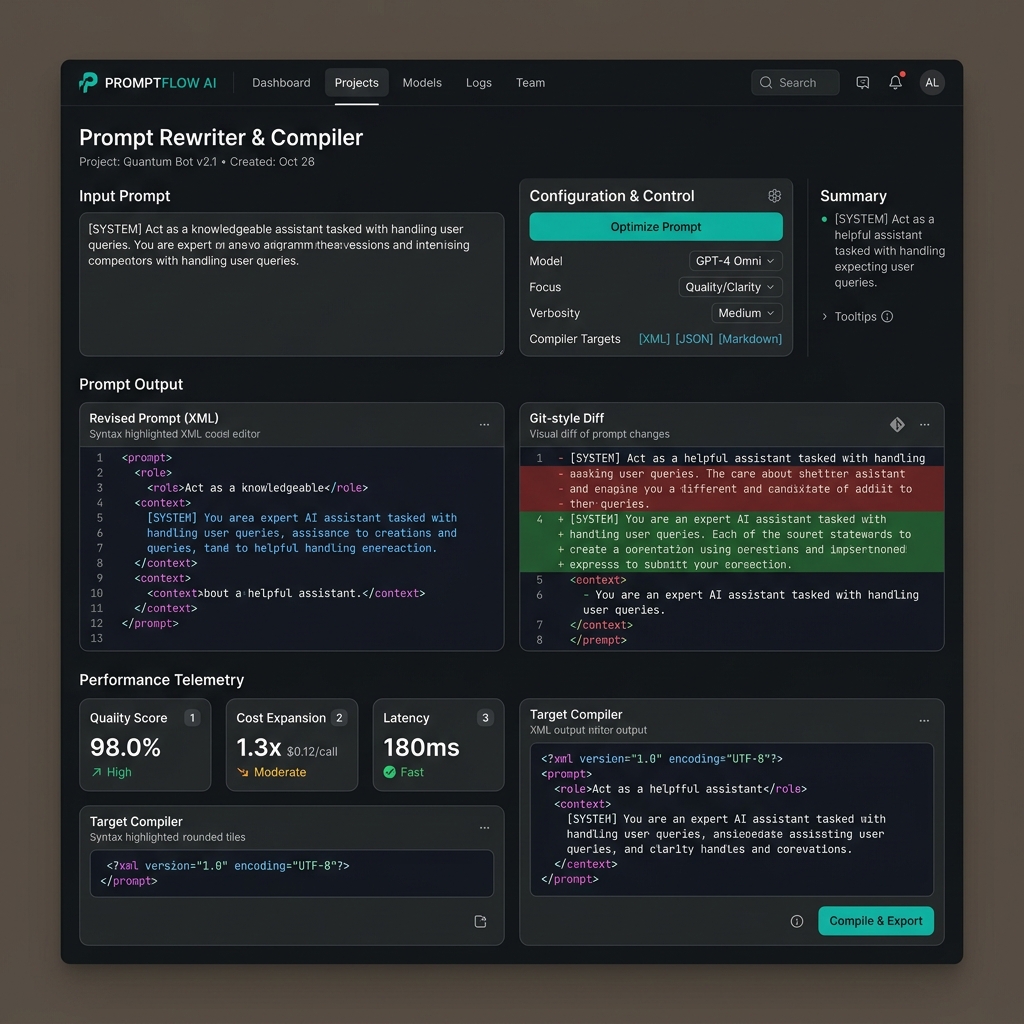
Seed text, RAG attachments, dynamic variables, constraints, and target model selector.
Line-by-line comparison highlighting additions (+) and deletions (-) relative to seed input.
Auto-generated web form fields allowing real-time variable testing before code deployment.
Frequently Asked Questions & Developer Knowledge Base
What is an AI Prompt Rewriter & Target Compiler?
An AI Prompt Rewriter & Target Compiler is an enterprise prompt engineering utility that ingests raw natural language drafts and compiles them into structured, deterministic system instructions tailored specifically for target LLMs like Anthropic Claude, Google Gemini, and OpenAI GPT.
Why is model-specific target compilation necessary?
Different frontier LLMs rely on distinct structural paradigms. Anthropic Claude achieves maximum instruction adherence using nested XML tags (<instructions>, <context>) and top-loaded context payloads. Google Gemini excels with Persona -> Rules -> Guardrails structures and typed parameters. OpenAI GPT performs best with Markdown headers (# SYSTEM ROLE) and JSON schema parameters.
How does top-loading context payload improve model accuracy?
Empirical LLM research proves that placing longform documentation, codebase signatures, or RAG context blocks near the beginning of the prompt payload—above operational queries—improves attention weights and reduces context hallucination by up to 30%.
What is the Multi-Metric Utility Formula U(P*)?
The utility formula mathematically evaluates prompt efficiency: U(P*) = S(P*) - alpha * C(P*) - beta * L(P*). It balances execution quality gain against normalized token cost expansion and latency overhead, allowing engineers to calibrate prompt length to their production SLA budget.
How does the Live Variable Tester & Form Hydrator work?
The workspace automatically scans input prompts for dynamic placeholders like {{VARIABLE}} and creates web form fields where developers can input real-time sample values to inspect the fully hydrated runtime user payload before deploying code.
Can I export compiled prompts directly into my software codebase?
Yes! The SDK & Code Bindings tab generates copyable code snippets for Python SDK (Anthropic, Google GenAI, OpenAI), TypeScript SDK, LangChain prompt templates, and VS Code / Cursor snippets.
Is the Prompt Rewriter Tool free to use on Axiqual?
Yes. Axiqual provides free web-based prompt tools including the Prompt Rewriter & Compiler, System Prompt Generator, Prompt Checker, and Prompt Length Optimizer to help engineering teams build trustworthy AI applications.
Ready to Compile & Optimize Your Enterprise Prompts?
Try the interactive Prompt Compiler console above or explore Axiqual's suite of developer quality utilities.